
Theories of government revenue explore how states fund public operations, focusing on the optimal mix of taxation, borrowing, and fees. These frameworks guide fiscal policy, aiming to balance economic growth, wealth distribution, and resource allocation while minimizing market distortions.
Approaches to Government Revenue
-
Benefit principle/approach of government revenue
This principle of government revenue argues that the government should collect revenue in proportion to the benefits the people receive from the government expenditure.
It means the government collects revenue for the expenditure, and different people receive different benefits from such government expenditure. So, the government should collect more revenue from those who receive more benefits and collect equal revenue from those who receive equal benefits from the government expenditure.
If the government uses this principle, it satisfies both vertical and horizontal equity, as well as the simultaneous determination of government expenditure and revenue.
To explain this, assume that:
- There are individuals ‘A’ and ‘B’ in the society.
- The total resources required for providing a public good are given.
- The total resources of the society are allocated to produce public and private goods.
- The benefits received from the public goods by the individual are expressed in terms of demand for it.

Here, OR* is the given resources of the society that are allocated to produce public and private goods.
DPA and DPB are the demand for public goods by A and B, respectively, and Dp A+B is the total demand of the public good in the society.
SP is the supply of the public good by the government, and the government provides the public good to meet its demand in society.
Both demand and supply of the public good in the society are equal at E*, implying that OP* is the optimum provision of the public good.
Now, the total government expenditure required to provide OP* public good is area OP*E*F*. For this, the government collects OP*A*A’ and OP*B*B’ revenue from A and B, respectively, such that OP*E*F* = OP*A*A’ + OP*B*B’.
This shows that the individual ‘B’ is paying more government revenue (tax) than ‘A’ to meet the government expenditure for public goods because ‘B’ is getting more benefit than ‘A’.
So, under this benefit principle, the government collects the revenue for the expenditure according to the benefit the people receive from the expenditure of the government.
Limitations/weaknesses of the benefit principle of government revenue.
- This theory is seriously criticized by arguing that the government should not act as the private sector, where the private sector charges the client according to the quantity of benefits they receive. So, the government should not beave as private sector because the government should have a welfare motive, but not a profit or revenue motive.
- Some of the government expenditure is pro-poor, which benefits mostly the poor or the low-income group of society. For example, increased expenditure on community health and education benefits the poor more, and if the government follows the benefit principle of revenue, then the poor have to pay more to the government, which is unjust (Anyayapurna).
- Under this principle, the government assesses the benefits from government expenditure in the form of the demand made by the people. When they know that they have to pay more if they make a higher demand, then they do not reveal their true demand for the public good. This makes it difficult to estimate the benefit the people receive from the public good.
-
Ability to pay principle/approach of government revenue.
Under this principle of government revenue, the government should collect the revenue from society according to the ability to pay of the individual or household.
This means that the different people in the society have different abilities to pay, and the government should collect higher revenue from those who have higher abilities to pay and equal revenue from those who have equal ability to pay.
So, this principle also satisfies vertical and horizontal equity.
There are different indicators of the ability to pay, and the most common of them are income, consumption, and wealth or assets. So, the people with higher income, consumption, or wealth are paying higher revenue to the government if the government uses the ability to pay principle.
To explain this, assume that income is the indicator of the ability to pay, and the government collects revenue or tax from the income of the people after a certain subsistence level of income.
Assume that,
- There are two individuals, ‘A’ and ‘B’ in the society.
- The total expenditure of the government is given.
- Marginal utility of income is diminishing.
- The government collects revenue only after subsistent level of income.
To collect the government revenue under the ability to pay principle, there are different approaches, which are:
- Equal absolute sacrifice (EAS)
- Equal proportional sacrifice (EPS)
- Equal marginal sacrifice (EMS)
1) Equal Absolute Sacrifice (EAS): Under this approach of government revenue, the government should collect the revenue in such a way that each individual has the feeling of equal sacrifice or loss in utility due to the payment to the government.
It means that when people are paying taxes or fees to the government, they are losing some part of the total utility given by the income. So, under the EAS, the government collects the revenue in such a way that each of them is feeling an equal loss in utility.
i.e. Loss in utility by A = Loss in utility by B
or, -ΔUA = -ΔUB
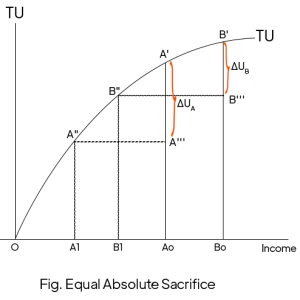
Here, Before Tax:
- Income of A = OAo Utility of A = A’Ao
- Income of B = Obo Utility of B = B’Bo
After Tax:
- Income of A = OA1
- Total utility of A = A”A1 = A”‘ Ao
- Loss in utility by A = A’A”’
- Tax paid by A = A1Ao
- Income of B = OB1
- Total utility of B = B”B1 = B”‘Bo
- Loss in utility of B = B’B”‘
Since the tax is imposed using equal absolute sacrifice, the loss in utility of A and B is equal, and B is paying more tax than A, and B has a higher ability to pay (income).
i.e. Loss in utility by A = Loss in utility by B
or, A’A”’ = B’B”’
Tax paid by A<Tax paid by B
i.e. A1Ao = B1Bo
and A1Ao + B1Bo = Total government expenditure.
2) Equal Proportional Sacrifice (EPS): Under this approach, the government collects revenue from society in such a way that every individual feels the sacrifice or loss in utility in equal proportion.
This means, due to the tax or revenue payments to the government, both individual A and B are losing the utility in equal proportion.
i.e., proportional loss in utility by A = proportional loss in utility by B.
or, -ΔUA /UA = -ΔUB/UB

Here,
Initially (Before Tax)
- Income of A = OAo
- Income of B = OBo
- TU of A = A’Ao
- TU of B = B’Bo
After Tax
- Income of A = OA1
- TU of A = A”A1 = A”’Ao
- Loss in utility = A’A”’
- Tax paid by A = A1Ao
- Income of B = OB1
- TU of B = B”B1 = B”’Bo
- Loff in utility by B = B’B”’
- Tax paid by B = B1Bo
Since the tax is imposed using equal proportional sacrifice (EPS), the proportional loss in utility by A & B is equal, and as B has a higher income, s/he is paying a higher tax than A.
i.e., proportional loss in utility of A =proportional loss in utility of B.
or, (A’A”’/A’Ao) = (B’B”’/B’Bo) and A1Ao + B1Bo = Total govt. revenue and A1Ao<B1Bo.
3) Equal Marginal Sacrifice (EMS): Under this approach, the government collects the revenue in such a way that every taxpayer feels the same level of marginal sacrifice. i.e., all of them have the feeling of equal loss in utility from the last unit of income paid as the tax. It implies that the tax is imposed so that after tax, income is equal for every individual in the society.
This is the most progressive form of taxation, which is theoretically acceptable, but practically it is questionable.
i.e. After tax income of A = After tax income of B.

Here,
Initial (Before Tax) situation
- Income of A = OAo
- TU of A = A’Ao
- Income of B = OBo
- TU of B = B’Bo
After Tax
Income of A = Income of B
- i.e. OA1 = OB1
- TU of A = TU of B
- i.e. A”A1 = B”B1
Since the tax is collected using the equal marginal sacrifice (EMS), the post-tax income and utility of both A and B are equal. As B has a higher income than A before tax, B is paying higher tax than A.
i.e. A1Ao < B1Bo
and A1Ao + B1Bo = Total govt. expenditure.
Conclusion:
Therefore, the ability to pay principle of the government. Revenue shows that both vertical and horizontal equity are satisfied if we collect the revenue according to the ability to pay of the people.
In order to measure the ability to pay, we can use different indicators such as income, consumption, and wealth.
Using them as the indicator of the ability to pay, the government can use EAS, EPS, and EMS, where EMS is the most progressive, and EAS is the least progressive.
Other Posts