Normal Goods: Goods whose demand increases when income increases. For eg, Branded clothes, smartphones. As your income rises, you tend to buy more branded clothes.
Inferior Goods:Goods whose demand decreases when income increases. For eg, Instant noodles, local bus rides, Street foods, and Footpath shopping. When people earn more, they may switch from instant noodles to healthier food, or from buses to taxis or street food to restaurants.
Giffen Goods (Special type of Inferior Good): Goods for which demand increases as price increases, due to lack of substitutes and income effect outweighing substitution effect. For eg, Basic staples like rice in poor households. If rice price rises, poor people might buy more rice because they can’t afford expensive foods and cut down on other items like meat.
All Giffens are Inferior but All Inferior are Not Giffen – Explanation
The goods with a negative income effect are inferior, and all the Giffen goods have a negative income effect. Which means all Giffens are inferior. But the negative income effect is not sufficient to be a Giffen commodity, which requires the absolute value of the income effect. It must be larger than the substitution effect to make the price effect and Giffen goods. However, some goods have a negative income effect, meaning they are inferior, but due to a larger substitution effect, the price effect is negative. This means such goods are not Giffen goods; they are inferior only or a normal good in terms of price effect.
In order to explain this consider 3 different goods X, Y and Z with their respective SE, IE and PE.
| Goods | S.E. | I.E. | P.E. | Remarks |
|---|---|---|---|---|
| X | SE | IE | PE>0 | |IE| > |SE| = Giffen |
| Y | SE | IE | PE>0 | |IE| > |SE| = Giffen |
| Z | SE | IE | PE | |IE| Normal from Price Effect |
This shows that all X, Y and Z are inferior because they all have negative income effect but only X and Y are Giffen as it has got positive IE. While Z is only inferior or normal from price effect.
In order to explain this, assume that there are two commodities X and Y where the price of X declines and X is Giffen or only inferior.
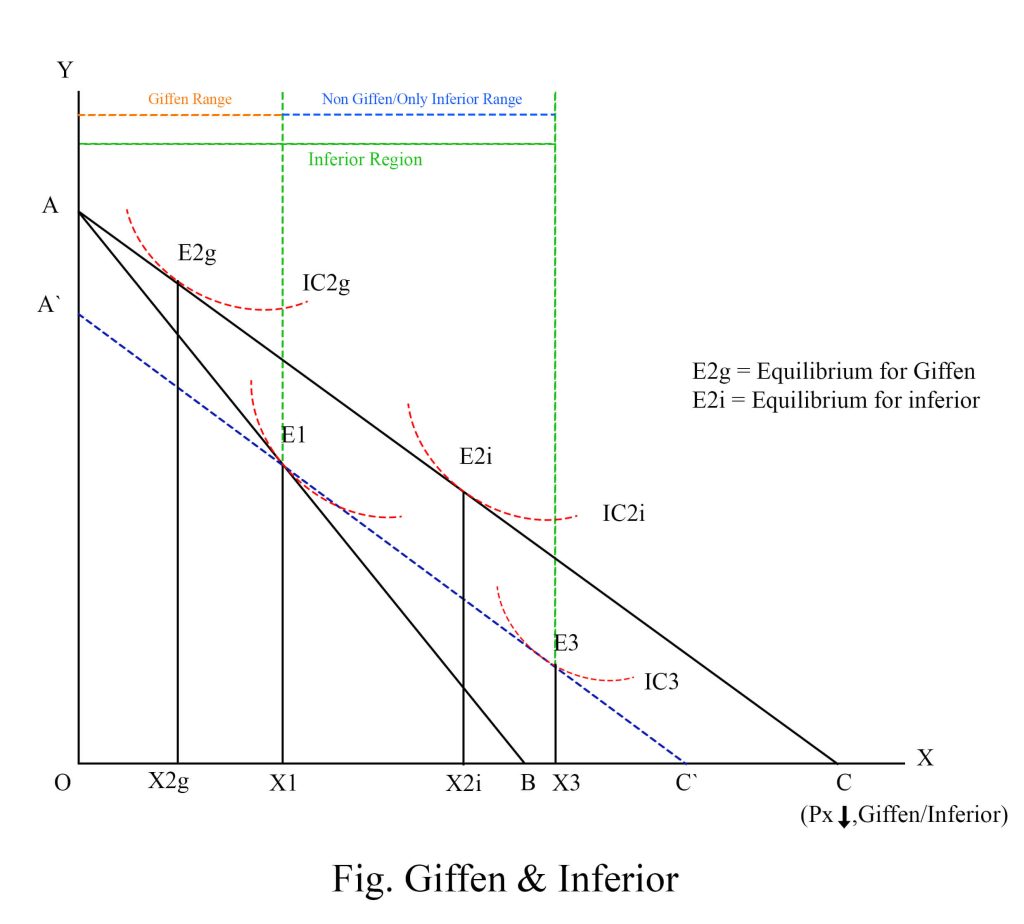
Here, initially the consumer is in equilibrium at E1 with OX1 units of X. Now assume that the price of X declines and so the budget line swings outward from AB to AC. If X is Giffen then its quantity should decline after its price declines due to the positive price effect. So, the consumer demands less than Ox1, when its price drops. Which means Ox1 = PQ the Giffen range. In the figure, the consumer attains new equilibrium at E2g with OX2g units of X if X is Giffen. This movement from E1 to E2g is price effect when X is Giffen.
i.e. PEg = X2gX1
If X is not Giffen, then the consumer consumes more quantity of X when its price declines. In this case the consumer attains new equilibrium at E2i with Ox2i units of X if it is inferior. This movement from E1 to E2i is price effect is X is non-giffen or inferior only.
i.e. PEi = X1X2i
In order to decompose this price effect into IE and SE, we have to keep the real income constant. In this case, real income of the consumer has increased due to fall in price of X. SO, following Slutsky method, we impose tax in such a way that the budget line after tax is A`C`. Which is passing through the initial equilibrium E1 and parallel to AC. If the real income is kept constant, the consumer attains new equilibrium at E3 with OX3 units of X. This movement from E1 to E3 is substitution effect.
i.e. SE = X1X3
If we refund such tax amount to the consumer, then she/he moves from E3 to E2g (if X is Giffen) and from E3 to E2i (If X is non-giffen or only inferior). Such movement is income effect.
i.e. IEg = X2gX3
Px (Drops), Real Income (M/Px) Rise, QdX (Drops) => IE < 0
Again, IEi = X2iX3
Px (Drops) Real Income (M/Px) Rise QdX, (Drops) => IE < 0
This means, all the given Giffens are inferior because Giffen goods have -ve income effect and +ve price effect. Such positive PE is due to |IE| > |SE|.
If such -ve IE is less than SE in absolute terms. i.e. |IE| < |SE| it makes PE -ve and such goods are only inferior not Giffen. They are not Giffen means they are normal in terms of Price Effect.
Similarly, this can be explained in terms of Giffen and Inferior range. In the figure above OX3 is inferior range because it shows negative IE and Giffen range show +ve price effect. The whole Giffen range is the inferior range which means all the Giffen goods fall under the inferior range.
Thus, All Giffens are Inferior but All Inferior are Not Giffen.