Both Hicksian and Slutsky methods are approaches for decomposing the price effect into the substitution effect and the income effect, where both of them show that real income should be kept constant to decompose the price effect. The basic difference between them is the definition of real income constant.
Hicks defines real income in terms of utility, and so constant real income means the consumer is still able to have the initial level of utility even after the change in price of a commodity. So, under the Hicksian method of PE decomposition, we impose a tax (if real income increases due to a fall in price) or provide a subsidy (if real income decreases due to a price increase) in such a way that the budget line after tax or subsidy is tangent to the initial IC and parallel to the new budget line.
Similarly, Slutsky defines real income in terms of purchasing power, and real income is said to be constant if the purchasing power of the consumer is constant even after the price change. So, under the Slutsky method of price decomposition, we impose a tax or provide a subsidy in such a way that the budget line after tax or subsidy passing through the initial equilibrium point is parallel to the new budget line, indicating that the consumer can have the initial bundle of utility.
Both of these methods can be used to decompose PE into SE and IE, but the Slutsky method is said to be relatively better than the Hicksian from the practical point of view due to the following reasons.
- Though the Hicksian method is theoretically good, but can not be used practically because the Hicksian method requires the exact shape and position of the IC to make compensation for real income constant. Since IE is a theoretical construct only, it is not visible and so can not be used for a practical purpose. But in the Slutsky method of price decomposition, we simply require knowing the initial bundle of commodities consumed by the consumer, and it is easily noticeable.
- From the social welfare point of view, the Slutsky method is better than the Hicksian because the Slutsky SE is higher than the Hicksian, and it puts the consumer at a higher level of satisfaction. So, the consumer or society prefers the Slutsky method of providing a subsidy or imposing a tax to keep constant real income.

Here, initially, the consumer is in equilibrium at E1 with OX1 quantity of X. Now, assume that the price of X declines, which shifts the budget line outward from AB to AC, and the consumer attains a new equilibrium at E2 with OX2 quantity of X. This movement from E1 to E2 is due to change in price oc X. So, it is called price effect.
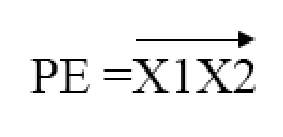
To decompose PE into SE and IE, we have to keep the real income constant in both the Hicksian and Slutsky methods. Since the real income of the consumer has increased due to a fall in the price of X, we impose tax in order to keep real income constant. Under the Hicksian method, the tax is imposed in such a way that the budget line after tax is AH CH, which is parallel to AC and tangent to IC1 and E3H. This implies that the consumer attains equilibrium at E3H with OX3H quantity of X.

If we refund tax, then s/he moves from E3H to E2, which is the income effect under the Hicksian method.

For Slutsky:
As Cs pass through the initial equilibrium, making a parallel to AC.
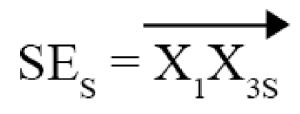

This shows that the price effect is the same in both approaches, but Slutsky SE is more than Hicksian, which keeps the consumer of higher IC3 level of satisfaction IC1.