Production Function:
- Technical relationship between the input and output
- It shows the technically efficient ways of producing the output
- Physical relationship between the input and output, and does not show the monetary or economically efficient way of production.
Capital = Man-made factors of production, such as physical capital or financial capital
Short-run Production Function:
Some factors are variable, and others are constant. i.e., at least one is variable, and the other is constant.
Short run
- Production – fixed and variable factors
- Consumption – income and consumption are non-proportional
- Income – If income is fluctuating
Long-run Production Function:
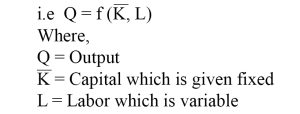
In the long run, the production function has all factors as variables
i.e., Q = f (K,L)
Where both K and L are variables.
Law of Variable Production Function:
It is the study of the behavior of short sun production functions.
| Land | Labor | Land:Labor | Output |
|---|---|---|---|
| 1 | 1 | 1:1 | 10 |
| 1 | 2 | 1:2 | 25 |
| 1 | 3 | 1:3 | 45 |
| 1 | 4 | 1:4 | 60 |
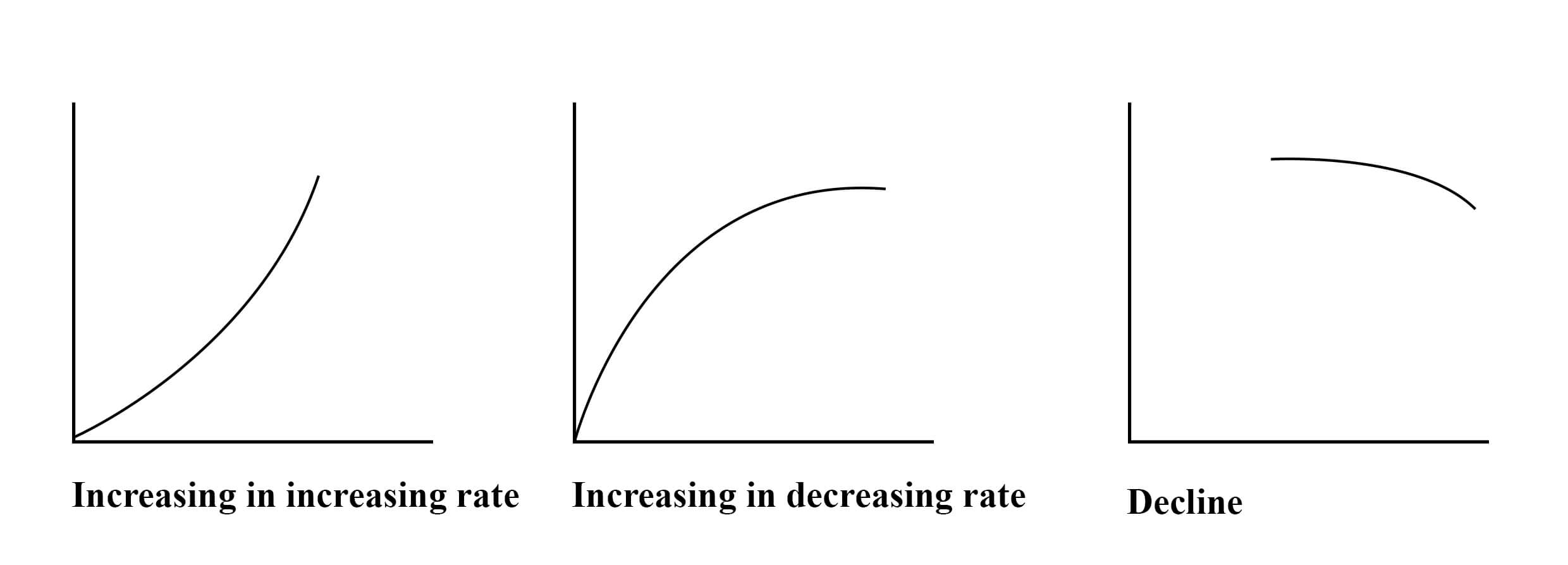
This law states that, initially when we increase the quantity of variable factor, the total product increases at in an increasing rate, the it increases at a decreasing rate and eventually the total product declines. This law explains the behavior of the producer in the short run.
This law is valid when the following conditions are satisfied:
- There must be at least one factor fixed, and another is variable.
- It is possible to combine fixed and variable factors in various proportions.
- Each unit of variable factor is homogeneous.
- Technology remains constant.
- The variable factor is divisible.
Based on these assumptions, the law of variable proportion assumes that there are two inputs, capital (K) and labor (L) with capital is assumed to be fixed and labor is variable.
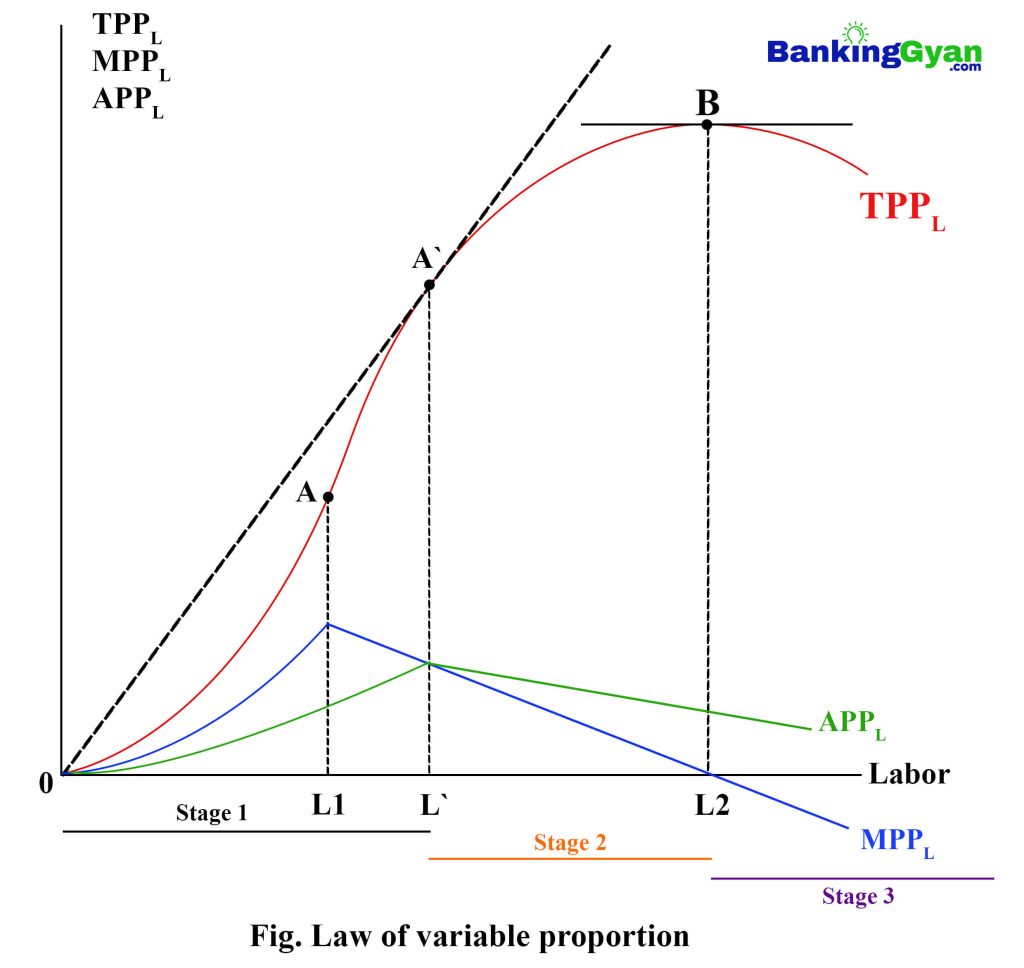
In this case, when we increase the quantity of labor initially, Total Physical Product of Labor (TPPL) increases at an increasing rate, then it increases at a decreasing rate, and finally declines. It means Marginal Physical Product of Labor (MPPL) and Average Physical Product of Labor (APPL) both are increasing, reach a maximum, and then decline.
| Capital | Labor | TPPL | APPL=TPPL/L | MPPL = APPL/ΔL |
|---|---|---|---|---|
| 10 | 1 | 10 | 10 | - |
| 10 | 2 | 25 | 12.5 | 15 |
| 10 | 3 | 45 | 15 | 20 |
| 10 | 4 | 60 | 15 | 10 |
| 10 | 5 | 70 | 14 | -5 |
Stage 1:
In this stage, initially TPPL is increasing at an increasing rate, then increases at a diminishing rate. MPPL is increasing initially, reaches a maximum, and then declines, but is still more than APPL.
APPL is increasing throughout this stage, and this stage ends when APPL is maximum. Or APPL = MPPL
The reasons for the occurrence of stage 1 are:
- Better utilization of fixed factors due to increasing units of variable factors.
- Benefits from labor division in the form of specialization and time saving when we increase the variable factor (labor).
Stage 2:
In this stage, TPPL is increasing at a decreasing rate. APPL is diminishing but is higher than MPPL. MPPL is diminishing but positive. This stage ends when is TPPL maximum or MPPL= 0.
The reasons for the occurrence of stage 2 are:
- Relative scarcity of fixed factors when we increase the variable factor continuously.
- A limitation of the labor division is that the productivity of labor declines if the labor division goes to a very small scale.
Stage 3:
In this stage, TPPL is diminishing. APPL is also diminishing, but can not be zero or negative. MPPL is negative. This stage in production occurs when the variable factor (labor) is in excess, and there is a huge shortage of the fixed factor. So, the variable factor does not get any fixed factor to work with, which demotivates or discourages them from working. So, the total product declines due to an additional variable factor (labor). It means the proverb “Too many cooks spoil the broth” is applicable in this stage.
Stage for a Rational Producer
A rational producer operates the firm in the stage at which the producer is able to maximize the profit. If the firm operates in stage 1, profit is not maximized because APPL is increasing which means the firm can increase profit by increasing labor.
It implies that there is a scope for maximizing profit in stage 1.
Similarly, in stage 3, MPPL is negative which means it is profitable to the firm to reduce labor which increases the total product. So, by operating in stage 3, the producer is not able to maximize profit. So, it is stage 2 where TPPL is increasing at a decreasing rate, or MPPL is diminishing but positive, as the appropriate stage for the rational producer.
However, it depends on the price of the product and the factor to find the exact point of operation in stage 2. If labor is relatively cheaper, the producer operates closer to the end of stage 2, and if labor is relatively expensive, then capital (fixed factor), the producer operates closer to the beginning of stage 2.
Hypothetically, if the labor is free, the producer operates at the end of stage 2, and if capital is free, then the producer operates at the beginning of stage 2.