Isoquant and Its Properties
| Labor | Capital | Output |
|---|---|---|
| 1 | 10 | 100 |
| 2 | 7 | 100 |
| 3 | 5 | 100 |
| 4 | 4 | 100 |
An Isoquant is a locus of points that represents various combinations of any two inputs that give the same level of output. If capital K and labor L are two inputs and Q represents the output, then the isoquant is defined as


Basic Properties of Isoquant:
1. Downward sloping: It is because of labor increase, then capital falls to keep the same level of output. Otherwise, the same level output can not be maintained.
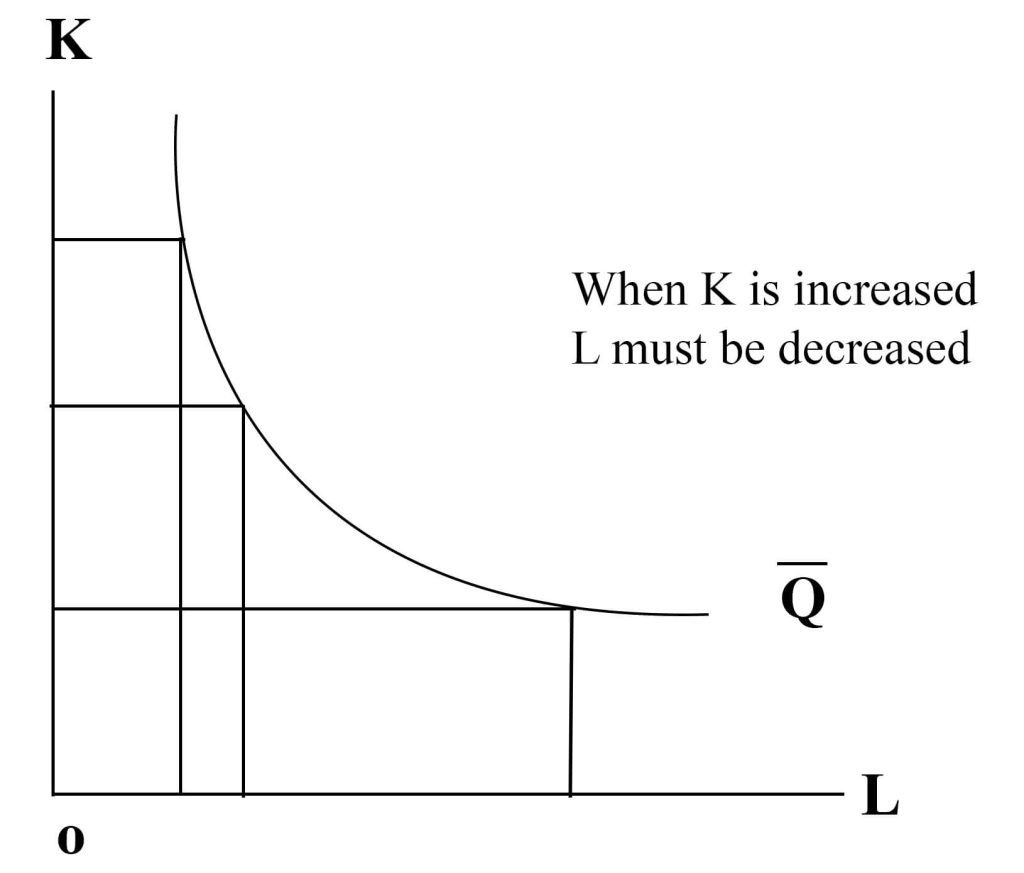
2. Convex to the Origin: Due to the diminishing marginal rate of technical substitution between labor and capital, called the marginal rate of technical substitution MRTSLC.
3. Do not touch either of the axes: Due to the indispensable (mandatory) nature of inputs. i.e., only K and K alone can not produce the output which is produced jointly by K and L.
If K =0, Q =0 and If L =0, Q = 0.
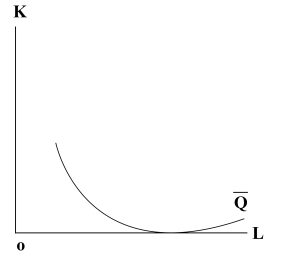
Here, if the isoquant touches the labor axis at A, it shows that OA units of labor can only produce a Q level of output, which is not possible because both K and L are indispensable factors of production.
4. Do not intersect any two isoquants with each other: Due to the transitivity property

Here,
Q1 isoquant = A = B = 100
Q2 = A = C = 200
But from the transitivity property,
B = C, but B is on the lower isoquant (Q1 = 100 units), and C is on the higher isoquant (Q2 = 200 units).
i.e., B ≠ C, which violates the transitivity property, which is not possible.
5. A higher isoquant means a higher output: A higher isoquant means a higher quantity of labor and capital. Where MPPL
0, MPPk > 0, and so higher units of L and K give higher levels of output.
