Topic – Economy, Trade & Industry
1) Which of the following statements is normative?
- Large government deficits cause an economy to grow more slowly.
- People work harder if the wage is higher.
- The unemployment rate should be lower.
- Printing too much money causes inflation.
Normative statements express opinions, value judgments, or what “ought to be”, not facts that can be tested. The other three are positive statements—they can be tested or verified with data.
2) If the price of a good is above the equilibrium price
- There is surplus (i.e. an excess supply), and the price will rise.
- There is a shortage (i.e. an excess demand) and the price will fall.
- The quantity demanded is equal to the quantity supplied, and the price will remain unchanged.
- There is a surplus (i.e. and excess supply) and price will fall.
Reason:
- If the price is set above the equilibrium price, producers are willing to supply more than consumers want to buy.
- This creates a surplus.
- To clear the surplus, sellers usually lower the price until it reaches the equilibrium level
3) If the interest falls, then
- Bond price will remain the same
- Bond price will fall
- Bond price will rise
- No effect on Bond price
Explanation:
When interest rates fall, the price of existing bonds rises because their fixed interest payments become more attractive compared to new bonds issued at the now lower interest rates. So, bond prices and interest rates move in opposite directions.
4) If investment becomes less sensitive to the interest rate, then the
- LM curve becomes steeper
- LM curve becomes flatter
- IS curve becomes steeper
- IS curve is relatively flat
Explanation:
- The IS curve represents equilibrium in the goods market, showing the relationship between interest rate and output.
- If investment becomes less sensitive to the interest rate, then changes in interest rates cause smaller changes in investment and thus smaller changes in output.
- This makes the IS curve steeper (because output changes less for a given change in interest rate).
5) Countries such as ………, that failed to adjust to a persistent external disequilibrium, were more vulnerable to poverty, displacement and ever war
- Japan & Korea
- Algeria and Yugoslavia
- Brazin and Argentina
- Singapore and Malaysia
6) In the Keynesian cross model, if the interest rate is constant and the MPC is 0.7, the the government purchases multiplier is
- 0.3
- 0.7
- 1.4
- 3.3
Explanation:
In the Keynesian cross model, the government purchases multiplier is calculated as:
- Multiplier = 1 / (1-MPC)
- Given MPC = 0.7,
- Multiplier=1 / (1 – 0.7) or, 1/0/3
7) In 2024, the nominal GDP growth of a country was 8% and the real GDP growth was 4%. What was the rate of inflation for that country?
- -4%
- 2%
- 4%
- 8%
Explanation:
To find the rate of inflation, we use the formula: Nominal GDP growth = Real GDP growth + Inflation rate
Given:
- Nominal GDP growth = 8%
- Real GDP growth = 4%
So, Inflation rate= Nominal GDP growth− Real GDP growth= 8% − 4% = 4%
8) The country where consumers had to wait in long lines to buy everyday items like bread. They did not have many choices and the government-controlled factories. What type of economy did they live in?
- Mixed economy
- Command economy
- Traditional economy
- Free market economy
A command economy is an economic system where the government or central authority makes all major decisions about production, distribution, and consumption of goods and services.
9) The Organization of Petroleum Exporting Countries (OPEC) is a(n) …. members agree to limit output and fixed prices.
- Monopoly
- Entropy
- Industry
- Cartel
A cartel is a formal agreement between competing firms or countries to coordinate their production, pricing, or marketing to control the market and maximize their joint profits. Currently, the OPEC has a total of 12 Member Countries.
9) If people with higher income pay a higher percentage of taxes in income, the income structure is…
- Progressive
- Regressive
- Value added taxes
- Exercise taxes
10) NNP at factor cost is equal to
- GNP at Market price – depreciation – indirect taxes + subsidies
- NNP at Market price – depreciation – indirect taxes + subsidies
- GNP + depreciation – indirect taxed + subsidies
- NNP + indirect taxes + subsidies
11) The monetary base for credit expansion refers to …
- High-powered money
- Low power money
- Hottest money
- Middle-powered money
12) As the price of the commodity rises from Rs. 10 to Rs. 12, its demand falls from 100 units to 50 units. The elasticity of demand is …
- 4
- 2
- 3
- 1
13) Which of the following indices measures poverty?
- Headcount index
- Squared poverty gap index
- Poverty gap index
- All of the above
Explanation:
- Headcount Index → Measures the proportion of the population below the poverty line.
- Poverty Gap Index → Measures the average shortfall of the poor’s income from the poverty line (depth of poverty).
- Squared Poverty Gap Index → Gives more weight to the poorest among the poor (severity of poverty).
Know More – Poverty Measurement Methods
14) Progress that meets the needs of the present without compromising the ability of future generations to meet their own needs is
- The Tragedy of the Commons
- Net primary productivity
- Sustainable development
- The impossibility theorem
Explanation:
This definition comes from the Brundtland Commission (1987) report, which describes sustainable development as meeting current needs without undermining the ability of future generations to meet theirs.
15) A(n) ……. is a bond that may be exchanged for common stock of the same corporation
- Exchangeable bond
- Convertible bond
- Debenture
- Warrant
16) The inflationary gap is associated with
- Keynes
- Gustav Causal
- Shapiro
- Samuelson
Explanation:
The concept of the inflationary gap was introduced by John Maynard Keynes. It refers to the situation where aggregate demand exceeds aggregate supply at full employment, leading to upward pressure on prices (inflation).
17) The renowned Bretton Woods Conference in 1944 was attended by
- 100 nations
- 75 nations
- 50 nations
- 44 nations
18) Too much money chasing too few goods is aptly described as
- Demand-pull inflation
- Cost push inflation
- Recession
- Depression
1. Demand-Pull Inflation
- Meaning: Inflation occurs when aggregate demand (spending) grows faster than aggregate supply.
- Cause: Too much money chasing too few goods.
- Example: Economic boom where wages and consumer spending rise quickly.
2. Cost-Push Inflation
- Meaning: Inflation occurs when production costs increase, forcing producers to raise prices.
- Cause: Higher wages, raw material costs, or supply chain disruptions.
- Example: Oil price hikes leading to higher transportation and manufacturing costs.
3. Recession
- Meaning: A period of economic decline lasting at least two consecutive quarters (6 months), marked by falling GDP, employment, and investment.
- Cause: Reduced consumer spending, high interest rates, external shocks, etc.
4. Depression
- Meaning: A severe and prolonged economic downturn, much worse than a recession.
- Characteristics: GDP falls sharply, unemployment is very high, and the economy stagnates for years.
- Example: The Great Depression (1929–1939).
19) The greater the beta, the ……. of the security involved
- Greater unavoidable risk
- Less unavoidable risk
- Greater avoidable risk
- Less avoidable risk
20) If there were a BoP deficit, then in a floating exchange rate system
- The external value of the currency would tend to fall
- The external value of the currency would tend to rise
- The injections from trade currency would tend to rise
- Aggregate demand is increasing
21) Tax is added to the price when
- Demand is elastic
- Demand is inelastic
- Supply is elastic
- Supply is inelastic
Demand is inelastic भनेको सानोतिनो परिवर्तनले उपभोक्ताको मागलाई घटाउन सक्दैन। यसो हुँदा कर सिमा थप गरे पनि माग घट्दैन।
Explanation:
- When demand is inelastic, consumers are less sensitive to price changes, so they will continue buying even if the price rises due to a tax.
- This allows sellers to pass most or all of the tax burden to consumers by adding it to the price.
- If demand were elastic, a price increase would cause a large drop in quantity demanded, making it harder to shift the tax to buyers.
22) Monetary policy affects the …… and …….
- Reserve and unemployment
- Taxes and exchange rate
- Money and supply
- Stock price and wage rate
23) The selling of Hyundai of its car cheaper in the US than at home (Korea) is known as …
- Subsidized import
- Dumping
- Internal economies of scale
- Export substitution
Explanation:
-
Dumping is when a company sells a product in a foreign market at a price lower than its price in the domestic market or below the cost of production, often to gain market share.
24) Two countries that still rely on the soviet communist model of development are
- Ghana & Nigeria
- China & USA
- Poland & Germany
- Cuba & North Korea
25) In the case of negative externality, the social marginal cost
- Exceed the private marginal cost
- Fall short of private marginal cost
- Be equal to private marginal cost
- Bear no significant relation to private marginal cost
26) If government intervenes in the Forex market to hold to value of currency up or down, it is called
- Hijacking of exchange rate
- Restriction of exchange rate
- Pegging of exchange rate
- None of these
Topic – Banking & Finance
1) A warrant is relatively …… option to purchase ….. at a specified exercise price over a specified period of time.
- Short-term; bonds
- Long-term; bonds
- Short-term; common stock
- Long-term; common stock
2) Cash Reserve Ration (CRR) was first suggested as credit control method by
- Gustav Cassa
- Milton Friedman
- Central Bank of Nepal
- J.M Keynes
3) Which of the following method is used by NEPSE to calculate index?
- Value weighted
- Price weighted
- Equal weighted
- Geometric mean
4) In case of Forex transaction
- Forward price is always greater than the spot price
- Spot price is always greater then forward rate
- Spot price and forward price are always equal
- None of the above
5) In the free market scenario and all other factors remaining the same, appreciation of Nepali Rupee would make Nepali exports
- More competitive in the international market
- There shall be no effect
- Less competitive in the international market
- Can’t say
6) The sensitivity of the bond price to changes in interest rate is called
- Bond sensitivity
- Bond volatility
- Price volatility
- Bond-price bondage
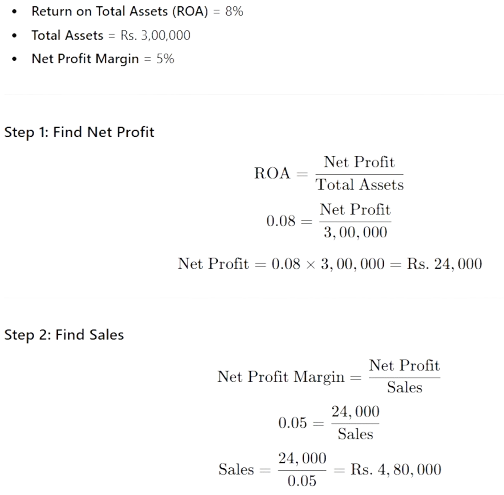
7) Usha Farm supplier has an 8% return on total assets of Rs. 3,00,000 and a net profit margin of 5%, What are its sales?
- Rs. 3,750,000
- Rs. 4,80,000
- Rs. 3,00,000
- Rs. 1,500,000
8) Blue chip shares (company) refers to
- Low quality shares
- Medium quality shares
- High quality shares
- Share whose value is rising
9) NASDAQ is the stock exchange of which country?
- New York, USA
- Tokyo, JAPAN
- London, UK
- Mumbai, INDIA
10) ……… is a market which deal long-period securities
- Capital market
- Money market
- Call money marker
- Treasury bill market
11) Which accounting standard is followed by NRB?
- NAS – Nepal Accounting Standards
- IAS – International Accounting Standards
- NFAS – Nepal Financial Accounting Standards
- None
12) ……varies inversely with profitability
- Liquidity
- Risk
- Blue
- False
13) An account opened by one bank in another bank is called
- Hostro account
- Nostro account
- Postro account
- Mostro account
14) Nepal Rastra Bank supervise
- Commercial bank
- Development Bank
- Finance companies
- All of the above
15) “Dear Money” policy is generally adopted during
- Recession
- Depression
- Inflation
- Boom
Cheap Money
- Meaning: Situation where interest rates are low, making borrowing easy and inexpensive.
- Purpose: Encourages investment and spending, stimulates economic growth.
- Example: Central bank reduces policy rates during a recession to boost the economy.
Dear Money
- Meaning: Situation where interest rates are high, making borrowing costly.
- Purpose: Controls inflation by discouraging excessive borrowing and spending.
- Example: Central bank raises policy rates when inflation is high.
16) Structural Adjustment Loan (SAL) is provided by
- IMF
- World Bank
- UNDP
- ADB
A Structural Adjustment Loan (SAL) is provided by the World Bank to support countries in implementing economic policy reforms, such as trade liberalization, privatization, and fiscal restructuring. The goal is to improve long-term economic efficiency and growth, often in coordination with IMF programs.
17) Beta coefficient of security is
- Unsystematic risk
- Systematic risk coefficient
- Total risk measure
- Per unit risk measure
18) Which sister Organization of the World Bank provides long-term loans at zero interest to the poorest developing countries?
- MIGA – Multilateral Investment Guarantee Agency
- IMF
- IDA
- IFC
MIGA – Multilateral Investment Guarantee Agency
- Part of the World Bank Group.
- Provides political risk insurance and credit enhancement to encourage foreign investment in developing countries.
IMF – International Monetary Fund
- Promotes global monetary cooperation, exchange rate stability, balanced trade, and financial stability.
- Provides short- to medium-term financial assistance to member countries facing balance of payments problems.
IDA – International Development Association
- Concessional lending arm of the World Bank Group.
- Provides low-interest or interest-free loans and grants to the world’s poorest countries.
IFC – International Finance Corporation
- Also part of the World Bank Group.
- Promotes private sector investment in developing countries through loans, equity investments, and advisory services.
19) Nepal became a member of the IMF on
- 1961 Sep 5
- 1961 Sep 6
- 1981 Sep 7
- 1961 Sep 8
Nepal also became a member of the World Bank (specifically the International Bank for Reconstruction and Development [IBRD]) on September 6, 1961
20) As per the NRB directive, BFIs should keep their account on
- IAS standard
- NAS standard
- Current yield of the bond
- All of the above
21) A project’s profitability index is equal to the ratio of the…… of a project’s future cash flows to the project’s ……
- Present value, initial cash outlay
- Net present value, initial cash outlay
- Present value, depreciable basis
- Net present value, depreciable basis
22) Standard and Poor’s is related to
- Credit rating
- Deposit rating
- Non-banking asset rating
- None of the above
23) All of the following are true of stock splits except
- Market price per share is reduced after the split
- The number of outstanding shares is increased
- Retained earnings are changed
- Proportional ownership is unchanged
- Market price per share is reduced → Because more shares are issued, the price adjusts proportionally
- The number of outstanding shares is increased → More shares after the split
- Retained earnings are changed → No effect on retained earnings; only the number of shares and par value per share change
- Proportional ownership is unchanged → Each shareholder still owns the same percentage of the company
24) An asset’s risk that can not be eliminated by diversification is called
- Premium risk
- Inherent risk
- Non-diversifiable risk
- Market risk
25) In estimating “After tax incremental operating cash flows” for a project, you should include all of the following except
- Sunk cost
- Opportunity cost
- Changes in working capital resulting from the project, net of spontaneous changes in current liabilities
- Effects of inflation
26) Which bank got the Award of “Bank of the Year 2025” in Nepal?
- Nabil Bank
- Global IME Bank
- Siddhartha Bank
- Citizens Bank (2024, 2025)
27) The rate at which the authorized dealer buys and sells the currency notes to its customers is called the
- Currency rate
- TT rate
- Cross rate
- Inter-bank rate
Topic – GK and ICT
1. Which country is a permanent non-member state in the General Assembly of the United Nations?
- Palestine
- Holy See
- None
- Both 1 and 2
Palestine and the Holy See (Vatican City) are permanent non-member observer states in the UN General Assembly.
2. Which Article of the Constitution of Nepal provides the right to freedom of religion?
- Article 24
- Article 26
- Article 28
- Article 29
3. Who is the inventor of the “Difference Engine”?
- Allen Turing
- Charles Babbage (Father of the Computer, First Mechanical Computer)
- Seymour Cray
- Augusta Adaming
- Alan Turing → Father of modern computing, worked on theoretical computers
- Seymour Cray → Supercomputer designer
- Augusta Ada King (Ada Lovelace) → First computer programmer, collaborator with Babbage
4. VGA stands for
- Video Graphics Array
- Visual Graphic Array
- Video Graphical Application
- Videos graphics Adaptor
5. Unwanted repetitive messages, such as unsolicited bulk email, are known as
- Spam
- Trash
- Callibri
- Courier
6. All computer programs for a machine are called
- Software
- Firmware
- Hardware
- None
7. Any device that performs signal conversion is
- Modulator
- Modem (Modulator Demodulator)
- Keyboard
- Plotter
- Modulator → Only modulates a signal, does not demodulate
- Keyboard → Input device
- Plotter → Output device for drawing
8. What is the minimum and maximum zoom size in MS Word?
- 10, 100
- 10,1000
- 10,500
- 50,1000
9. Which one of the following is DOS based spreadsheet package?
- Word
- Smart Cell
- Excel
- Lotus 1-2-3
Similar Sets
- NRB Assistant Director Pretest Set 7
- NRB Assistant Director Pretest Set 2
- NRB Assistant Director Pretest Set 3
- NRB Assistant Director Pretest Set 4
- NRB Assistant Director Pretest Set 5