What is an Oligopoly Market?
It is the market structure in which there are few sellers (two or more), a limited (or given) market, and almost identical, very close substitutes. Due to the given size of the market, there is a significant interdependence, where the strategy of one firm directly affects the outcome of another. Therefore, there is an intense rivalry among the firms due to the given market size, which may lead to a level of cutthroat competition.
Based on the nature of the oligopoly market, it can broadly be classified into
- Collusive Oligopoly Market
- Cartel
- Joint Profit Maximizing Cartel (Syndicate)
- Market Sharing Cartel
- Market sharing by non-price competition
- Market sharing by quota or quantity
- Market sharing by specific area or product
- Price Leadership
- Low-cost firm price leadership
- Dominant firm price leadership
- Barometric firm price leadership
- Cartel
- Non-collusive Oligopoly Market
In a collusive oligopoly, the firms voluntarily form a group in order to control the market outcome to favor them by minimizing the risk and uncertainty arising from the given market. While in the non-collusive oligopoly, each firm competes individually using its best strategy under the assumption regarding the strategy of other firms.
1) Collusive Oligopoly
In this type of oligopoly market, there is a group of firms that name some agreements regarding the price, output, or other strategies which the follow jointly. Such agreements are made to protect and promote their interest and avoid the risk and uncertainty of competing individually.
There are two types of collusion in the oligopoly market, such as
- Cartel
- Price Leadership
1. Cartel
A cartel is a group of firms in the oligopoly market that makes secret agreements regarding price or output, or both, in order to protect and promote their common interest. This avoids the risk and uncertainty arising while competing individually. The agreements are tacit or secret because an open cartel is illegal.
Types of Cartel
- Joint Profit Maximizing Cartel (Syndicate)
- Market Sharing Cartel
- Market sharing by non-price competition
- Market sharing by quota or quantity
- Market sharing by specific area or product
1. Joint profit-maximising cartel (Syndicate)
In this type of cartel, all the member firms of the group select a central agency. The power to determine the profit-maximising price and the output of the whole industry is given to the central agency. The central agency is also responsible for allocating such profit-maximising output to each of the member firms.
In this model, it is assumed that the central agency has the information about the market demand and the marginal revenue of the market. It has all the information about the cost structure of each member firm. Then, by horizontal summation of the marginal cost of member firms, the central agency estimates the marginal cost of the whole industry. Then, by using the marginalist principle of profit maximisation, the central agency determines the price and output of the industry that maximizes the joint profit.
After determining the profit-maximizing output of the industry, the central agency allocates this output to each of the member firms in such a way that the marginal cost of each firm equals MC and MR of the industry at the equilibrium level of output.
In order to explain price and output determination under this model, assume that there are two firms, A and B, which agree to have a jount profit maximizing carteling.
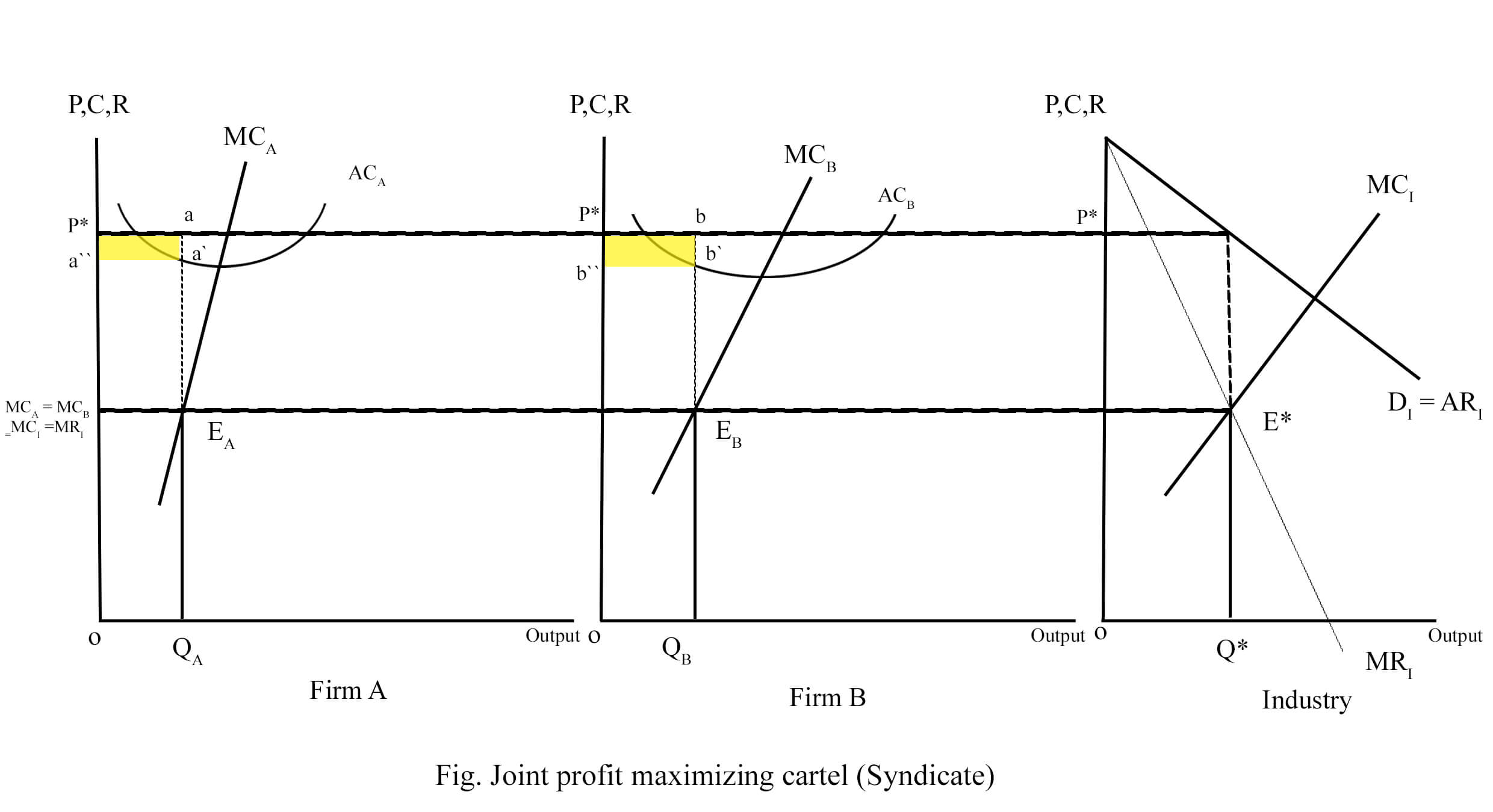
Here,
The central agency has estimated the demand and marginal revenue of the industry as DI and MRI, respectively. The marginal cost of the industry is computed as MCI = MCA + MCB
As the objective is to maximize the joint profit of the firms (industry profit), both conditions of profit maximization are satisfied at E* with P* price and OQ* quantity of industry.
Now, P* is the given price for both firms, and the central agency has allocated this profit-maximizing output to firm A and firm B as OQA and OQB, respectively, so that OQA = OQB = OQX and MCA + MCB = MCI = MRI
The firm A is earning AREA a a` a“ P* profit, and firm B is earning b b` b“ p* profit. So, the maximum joint profit of the industry is Area a a` a“ P* + b b` b“ p*
2. Market Sharing Cartel
In this type of cartel, all the member firms sit together to have a common strategy on the price and output in order to secure their interest and avoid the risk and uncertainty of competing independently. All the firms equally participate to make a common decision regarding the price and output. There can be different forms of market sharing, such as:
- Market sharing by non-price competition
- Market sharing by quota or fixed quantity
- Market sharing by product sector or geographical area
1. Market sharing by non-price competition
Under market sharing by non-price competition, all the firms agree to have a common price, and they compete with each other using non-price strategies such as packaging, branding, marketing, texture, after-sales service, etc. The price is common for all the products, and the price is determined by bargaining among the firms. In the bargaining, all the firms of the group participate equally, where the high cost firms may bargain for a higher price, and the low cost firms bargain for a lower price in order to sell more. The agreed price is such which gives at least some profit to all the member firms.
2. Market sharing by quota or quantity
In this type of market sharing, all the member firms of the group agree to have a fixed quota or quantity to supply in the market. Such a quota is determined by the bargaining among them. While bargaining for a quota, the past sales history and supply capacity of the firm are considered. So, the firms agree to supply the fixed quantity or quota in the market. Such a quota may be equal or unequal, given the bargaining power of the firm. The price may be the same or slightly different, given the cost under the location of the firm.
3. Market sharing by specific product of location
In this type of market sharing, the firms agree to share the market by geographical area of specific products or sectors. This is all determined by bargaining among the firms. The price may or may not be the same, given the differences in the cost of production. The price and output determined by the bargaining should give at least some profit to all the involved firms.
Since there are no specific rules for determining the share of the market, the bargaining among the firms ultimately determines the market sharing strategy. To explain graphically, assume that there are two firms, A and B, which agree to have a market-sharing cartel.
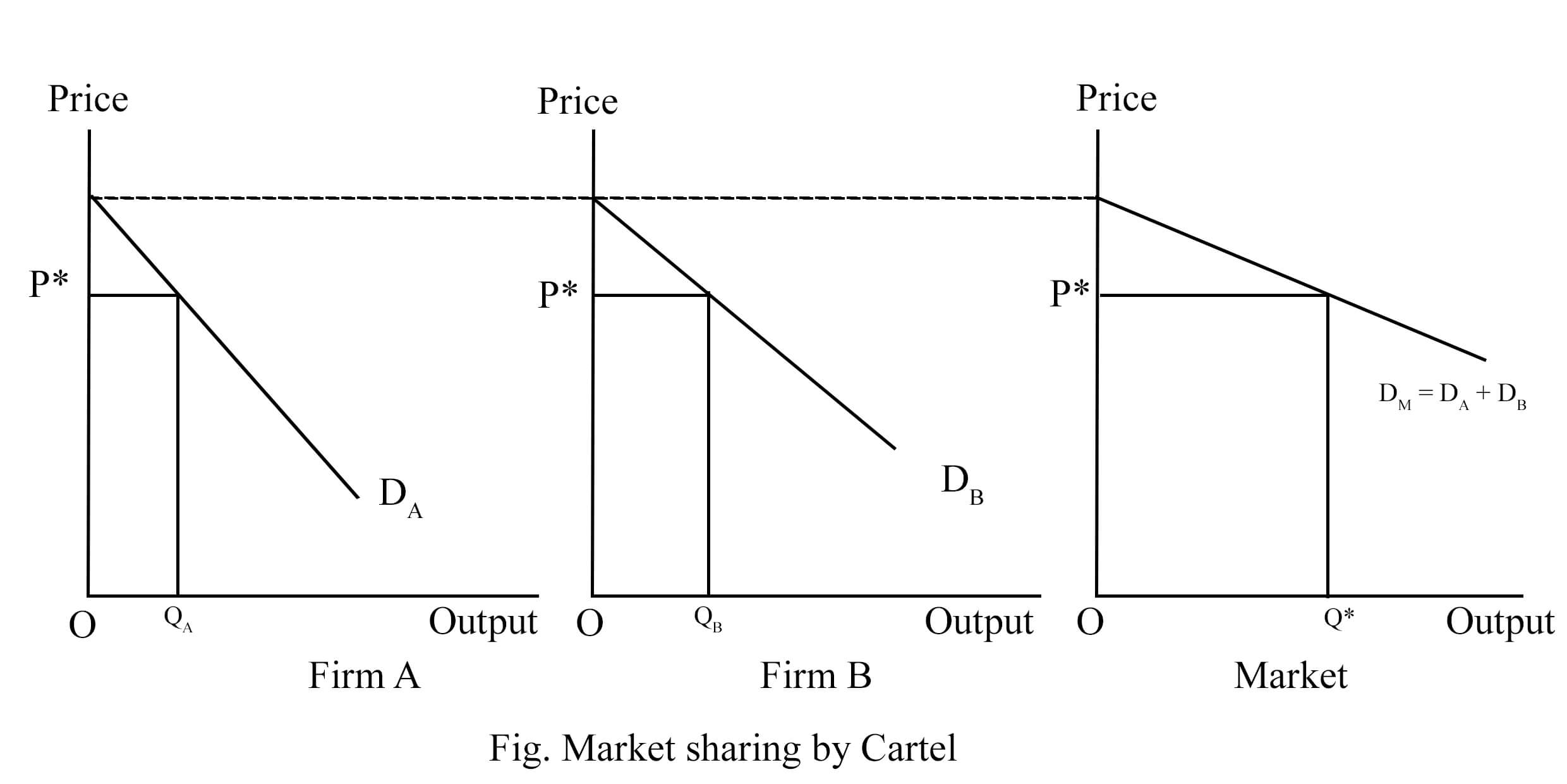
Here,
DA and DB are the demand of the product for firms A and B, respectively, DM is the market demand
i.e. DM = DA + DB
P* is the common price determined by bargaining, which gives at least some profit to both firms. At the agreed price P*, OQ* is the total quantity demanded, which is shared by the firms A and B, respectively, as OQA and OQB, such that
OQA + OQB = OQ*
2. Price leadership model of oligopoly
In this type of collusive model, there is a firm in the group that is accepted as the leader by other firms. Being the leader of the group, the leader firm uses marginalistic criteria of profit maximization to determine its price and output, and the rest of the other firms follow the price set by the leader. The followers may not be maximizing their profit, but in order to avoid risk and uncertainty in competing with the leader firm individually, they accept the price of the leader, which gives them at least some profit.
Types of leadership selection
- Low-cost firm price leadership
- Dominant firm price leadership
- Barometric firm price leadership
1. Low-cost firm price leadership
In this model of price leadership, the firm with the lowest cost in the industry is accepted as the leader by high-cost firms. So, the low-cost firm (the leader) uses the marginalist principle of profit maximisation to determine its profit-maximising price and quantity. Then the high-cost firm follows the leader’s price, which may not be profit-maximising for it but yields at least some profit to all.
To explain price and output determination under this model, assume that there are two firms, A and B, with respective demand and marginal revenue as DA, DB, and MRA and MRB.
They agree to have a low-cost price leadership model to determine the price and output.
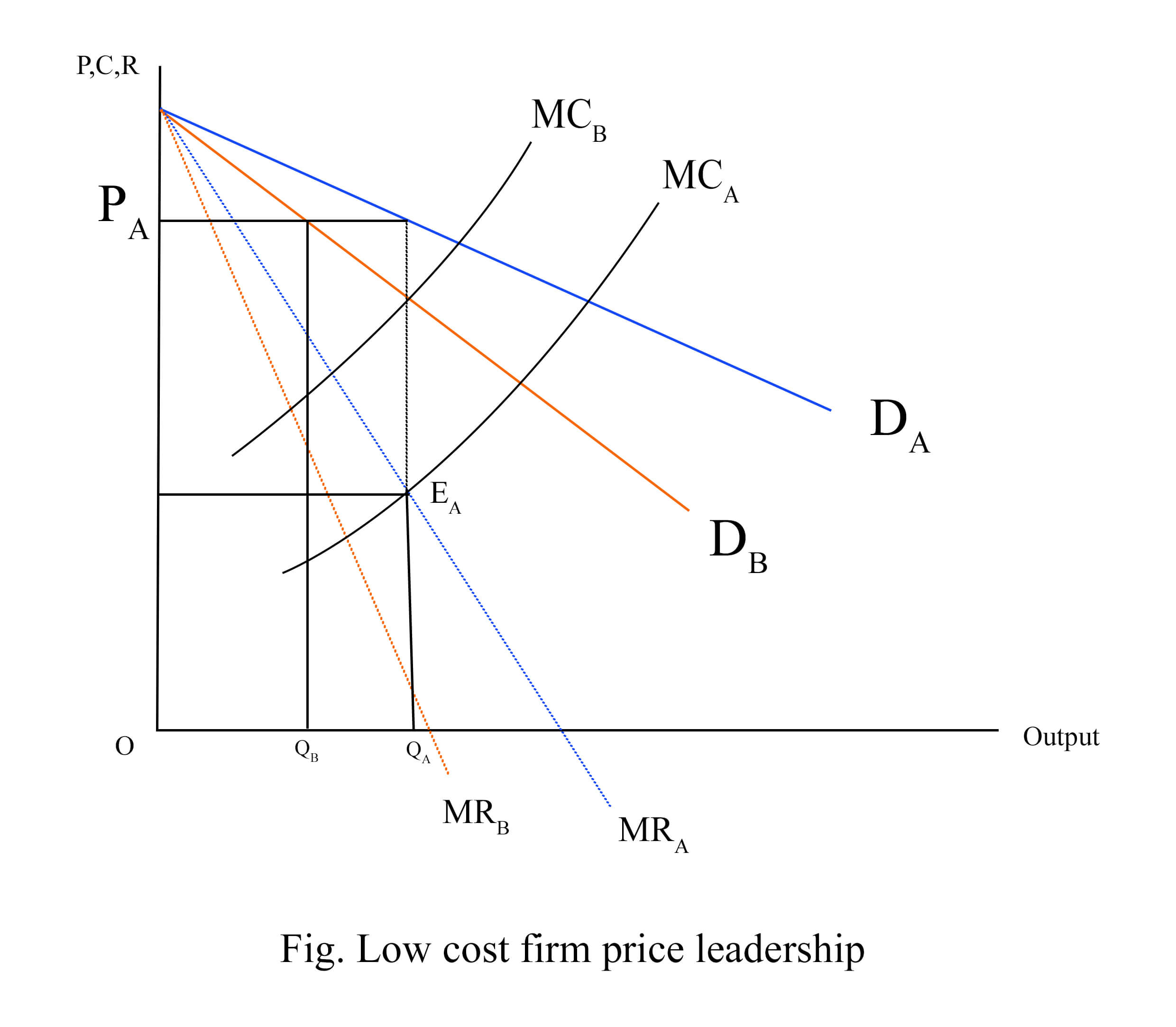
Here, MCA < MCB, the firm A is the low-cost firm. So, firm A is the leader and firm B is a follower.
- The firm A, being the leader, determines its own profit-maximising price and output where both conditions of profit maximisation of the firm A are satisfied at EA. So, the firm A produces OQA quantity of PA price in order to maximise profit.
Since firm B is the follower, the price PA is given to firm B at which firm B supplies OQA quantity. At the PA price and OQB quantity, the profit-maximising criteria of firm B are not satisfied, which means firm B is not maximising profit at the price PA but should give the same profit. Therefore, in the low-cost firm price leadership, the firm with the lowest cost in the group is the leader and the higher cost firm are he follower of the price, which gives them some profit.
2. Dominant firm price leadership
In this model of price leadership, there is a firm in the market that has a substantially large market share relative to other small firms. Such large firms are called dominant firms, which determines its profit maximizing price and output, and the rest of the other small firms follow the price that gives them some profit but not maximum.
In this model, it is assumed that the dominant firm has the information on market demand and supply by the small firms. Then, the dominant firm determines its own demand as the gap between the market demand and supply by the small firms. i.e., Demand of dominant firm (Dd) = Market Demand (Dm) – Supply by small firms (Ss).
If Dm = Ss, then Dd = 0
If Ss = 0, then Dd = Dm
Similarly, the dominant firm has the information about its own marginal cost, then by using the marginal criteria of profit maximisation, the dominant firm determines the price and output that small firms have agreed to accept the price set by the dominant firm, and at this price, they earn some profit.
- Price High ⇒ Dm Low ⇒ Dm = Ss, then Dd = 0
- Price Low ⇒ Dm high ⇒ Ss =0, then Dc = Dm

Here,
Dm is the market demand of the product, and Ss is the supply by the small firms. If price is P’ or above, then the whole market demand is supplied by the small firms, and the market does not need the dominant firm. So, the demand os the dominant firm begins from price p’. Similarly, if the price is Po or below, the small firms can not supply, and the whole market demand is of the dominant firm. So, below the price Po, there is a dominant firm only as the monopolist, which makes the demand curve of the dominant firm KINKED at the Po price.
Based on this demand curve of the dominant firm, the marginal revenue is MRd, and the marginal cost of the dominant firm is MCd. Since the dominant firm is the leader, it determines the profit-maximizing price and quantity using the marginalist criteria. Both conditions of profit maximising are satisfied at Ed, and so the profit-maximising price and quantity of the dominant firm are Pd and OQq respectively.
Since it is the dominant firm’s price leadership mode, the price determined by the dominant firm is the market price, and at the market price Pd, the total market demand is PdA, out of which the small firm supplies PdB and the dominant firm supplies BA = OQd.
Therefore, in the dominant firm price leadership model, the large or dominant firm is accepted as the leader by the small firms, where the dominant firm determines the profit-maximizing price and quantity. The small firms accept the price of the dominant firm, which gives them at least some profit, but may not be profit-maximizing. But there is risk and uncertainty in competing independently with the dominant firm; the small firm accepts the price of the dominant firm.
3. Barometric firm price leadership
In this type of price leadership, there is a firm in the market which is assumed to predict the market more accurately, and such a firm is known as barromatric firm, which is accepted as the leader by other firms.
The marometric firm may be from the same industry or another, but it should have a good reputation among others as the forecaster of the market and the economy. This may be from the historical legacy or due to better access to information, better resources, and technology of market analysis and projection that make the firm a leader.
It is agreed that the barometric firm shares the information about the market analysis and projection with the group. Then each member firm of the group uses the information to optimize the goal.
For example, if the barometric firm projects that the market will shrink by 10% in this quarter and further will decline by 15% in the next quarter, then the follower firms adjust their production and sales activities accordingly to minimize loss.
Non-Collusive Oligopoly (Kinked Demand Curve Model)
Other posts